
AM & AI: Two Technologies That Work Together
Written By Tim Simpson, Fellow Advisor® | Featured in Additive Manufacturing Media
AI is everywhere these days, and additive manufacturing (AM) is no exception. Whether it is sifting through material test data, in-situ monitoring results, or x-ray computed tomography images, AI has no shortage of ways to help AM.
AI can be used across the entire AM value chain. For instance, AI can be used to identify existing parts in inventory to make with AM or generate new designs for AM. AI can be used to find optimal build orientations to minimize support structures, reducing build time, material costs and post-processing headaches. AI also promises to accelerate material and process qualification efforts by identifying robust process parameter windows with fewer builds and less testing. For example, earlier this summer, America Makes announced winners for an AI-based qualification project, Artificial Intelligence for Material Allowables in Additive Manufacturing (AIM-4AM), which seeks to reduce physical testing and quantify risks faster when developing materials allowables.
The real challenge, then, is figuring out where you want to start using AI in AM while keeping tabs on the latest advances in AI—not an easy feat given how rapidly AI is changing.
Implementing AI for Various Use Cases
So where to begin? Up until a few years ago, you would search Google for something like, “AI in additive manufacturing” and get several billion results to sift through. Now, even AI has changed that. Search engines start with an “AI Overview” before the sponsored ads and links to all the search results. It is too easy to click on the “Show More” button, read the AI Summary and think you are prepared for your journey—but that is only one path, and it may not be the right one for what you are trying to do. Make sure to scroll through the search results to make an informed decision before you start heading in the wrong direction.
In this upcoming series of AI-focused articles, featured on Additive Manufacturing Media, I plan to explore and highlight some of the different uses of AI in AM that add value, save time/cost or improve quality. This first article serves as an introduction and touches on a few uses at a high level. It also ends with a cautionary tale reminding you that AI can generate inaccurate or misleading results, i.e., “hallucinate” as the industry calls. My subsequent articles will dive deeper into how various stakeholders in the AM value chain (e.g., design engineers, manufacturing/process engineers and quality control personnel) can use AI to do their job better, faster or cheaper. AI’s uses in AM are growing exponentially, and my word count is limited; so, I’ll highlight as much as I can to inspire you on your journey.
Personally, I have found that the best way to learn AI is to use it on a back-burner idea or personal project. I have tried taking several “Intro to AI” classes, but until I had something specific I wanted to do (e.g., research a topic in depth, compile a list of online resources, synthesize survey results, convert a document into a presentation), my interest in the course quickly waned.Plus, once I got comfortable asking the AI how to do something, I found that I could work with and learn from the AI at the same time. In essence, AI combines “just-in-time learning” with “hands-on learning” to accelerate whatever you are trying to accomplish.
So, if you are not using AI already, pick one (e.g., ChatGPT, Claude, Gemini, Copilot, etc.) and start using the free version if you do not want to pay the monthly fee. Once it is set up and running, just start prompting it and asking questions. Since we are discussing AI in AM, here are some ideas to get you started and some things I have done:
New to AM? If so, you can tell the AI to “provide a summary of the different additive manufacturing processes and materials available for [application]”. It will generate a document summarizing what it found, or you can ask it to create a presentation of the results or compile a spreadsheet of the different systems available from vendors (or do all three). Some AIs can even generate a podcast of its findings if you prefer to listen instead of read the results. Don’t know if your AI can do this? Just ask it!
Want to dive deeper into a specific AM process? Ask the AI to “provide a detailed listing of laser powder bed fusion (LPBF) systems available in the market for printing metal, including materials available and build envelopes”. Again, you can specify how you want the information presented and what level of details you want to see. You could also follow that up with “compile a list of post-processing needs for these systems” to learn more about part production with AM, not just 3D printing. Alternatively, you can ask AI to “summarize the different types of flaws and defects that can occur in LPBF of metals and list ways to mitigate them” to assuage some of the fears you may have heard about AM.
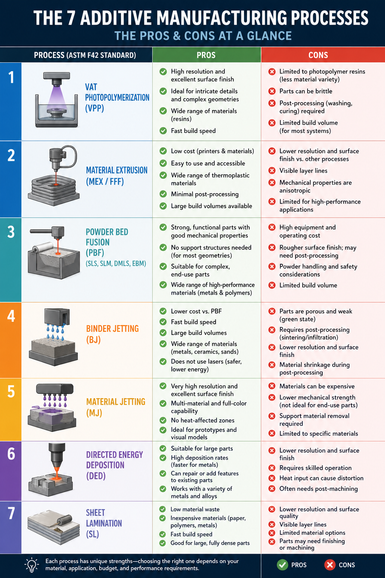
Image generated by ChatGPT v5.5 based on prompt: “Create an infographic that highlights the pros and cons of the 7 additive manufacturing processes that exist.” Source: ChatGPT
Want to know what AM standards are relevant as you shift to production? Ask the AI to “compile a list of relevant additive manufacturing standards [for application] and include links to each.” While most standards must be purchased and restrict their use with AI, open standards like NASA-STD-6030 can be uploaded into AI and then queried or summarized into a check list or implementation plan. In fact, if you use ChatGPT, go to “…More”, select “GPTs”, and search for “AMGPT” (by Ethan John Wicko, a former NASA intern), which has already been trained on 6030 and its sister document NASA-STD-6033. Now you can ask AI, “how many and what types of test specimens do I need for a [criticality level] part?” and not have to sift through all 190 pages. The U.S. Navy’s Digital Sea is another good resource for Tech Pubs, Guidance Letters and material and process specifications for metal AM.
Want to know how AI is being used in AM? Ask the AI, “what are the latest trends for using AI in AM?” and see what list it generates. I did this in preparation for writing these articles and asked the same question to three different AIs. The results varied quite a bit in terms of breadth, depth and supporting references. This is due in part to the sophistication of the different AI algorithms and to the lack of specifics in my prompt, which left a lot open to interpretation by the AI.
Finally, don’t be afraid to test some of the new features whenever an AI is updated. For instance, when ChatGPT released v5.5, I saw a post on LinkedIn marveling at how much the image generation capabilities had improved. I see a lot of infographics floating around on LinkedIn, and I decided to see what the new image capabilities could do for AM.
My prompt was simple: “create an infographic that highlights the pros and cons of the 7 additive manufacturing processes that exist,” and I was impressed by the results: visually appealing text and formatting, clear and succinct list of pros and cons, and illustrations of each AM process. Unfortunately, a lot of the “pros and cons” oversimplify things too much, and one of the process images is very wrong (can you tell which one?).
So, while AI can do a lot and do it fast, it functions best when it is combined with subject matter expertise to evaluate (and correct) the results. Otherwise, you might think material extrusion systems are equipped with lasers that melt plastic.